
Quantum geometric tensor#
In this example, we examine TBModel’s berry_curvature() and quantum_metric() derived from the quantum_geometric_tensor().
TBModel can compute the quantum geometric tensor for both 2D and 3D models. Here, we illustrate its use for a 2D model. The quantum geometric tensor is defined as
The function quantum_geometric_tensor() returns the quantum geometric tensor \(Q_{\mu \nu;\ mn}(k)\), from which the Berry curvature and quantum metric can be derived as
In the Abelian case (i.e., trace over band indices), these reduce to the familiar expressions for the Berry curvature and quantum metric.
import numpy as np
import matplotlib.pyplot as plt
from pythtb.models import haldane

my_model = haldane(delta=0, t1=-1.0, t2=-0.15)
# Generate k-points
nkx, nky = 20, 20
k_pts = my_model.k_uniform_mesh([nkx, nky])
Berry curvature#
As of v2.0, the TBModel class has the ability to compute the velocity operator as
From this, we can also compute the Berry curvature arising from band mixing,
In v1.8, the Berry curvature was only accessible through the WFArray class using the plaquette approach. Now, we can compute it directly from the TBModel.
There are a few notable features of this berry curvature implementation:
The Berry curvature is computed using the Kubo formula above, which captures inter-band contributions to the Berry curvature. This assumes a global gap between the band of interest and all other bands. The bands of interest are specified using the
occ_idxsargument.The Berry curvature is computed at arbitrary k-points, which we generate using the
k_uniform_meshfunction.There is a
cartesianparameter to specify whether the output Berry curvature is dimensionful or in reduced units.There is a
planeparameter to specify the 2D plane in k-space over which to compute the Berry curvature. If not specified, the returned array’s first two axes correspond to the indices of the reciprocal lattice vector directions.The Berry curvature has a flag for
non_abeliancomputation, which allows one to compute the non-band-traced Berry curvature for a manifold of bands.
The full shape structure is (dim_k, dim_k, n_k, n_occ, n_occ) for the non-abelian case, and (dim_k, dim_k, n_k) for the abelian (band-traced) case.
b_curv_na = my_model.berry_curvature(
    k_pts=k_pts, occ_idxs=[0], cartesian=True, non_abelian=True
)
print(b_curv_na.shape)
(2, 2, 400, 1, 1)
By definition \(\Omega_{ij} = -\Omega_{ji}\) and \(\Omega_{ii} =0\), so we should always expect berry_curv[i,i] = 0 and berry_curv[i,j] = -berry_curv[j,i].
print(np.allclose(b_curv_na[0, 1], -b_curv_na[1, 0]))  # should be True
print(np.allclose(b_curv_na[0, 0], 0))  # should be True
print(np.allclose(b_curv_na[1, 1], 0))  # should be True
True
True
True
TBModel allows us to obtain a Chern number for a gapped manifold of states using the above Berry curvature implementation. In this case, we can compute the Chern numbers for the upper and lower bands.
.. note::
For higher-dimensional k-space systems, we should specify the 2D plane in k-space over which to compute the Chern number using the plane argument.
print(
    "Chern number band 0:",
    my_model.chern_number(plane=(0, 1), nks=(200, 200), occ_idxs=[0]),
)
print(
    "Chern number band 1:",
    my_model.chern_number(plane=(0, 1), nks=(200, 200), occ_idxs=[1]),
)
Chern number band 0: 1.0
Chern number band 1: -1.0
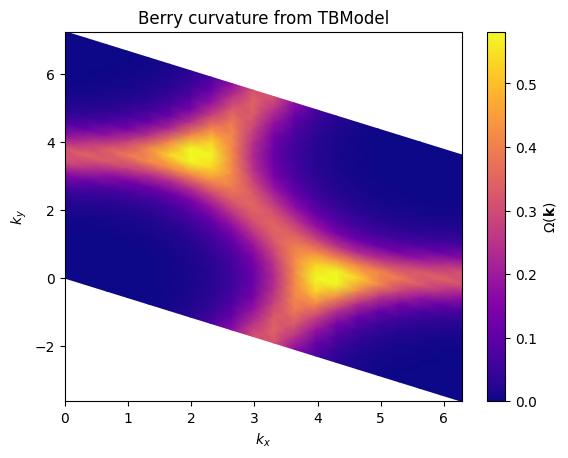
We can visualize the Berry curvature distribution for the occupied band in the two-dimensional Brillouin zone.
We again call berry_curvature passing the array of k-points and occupied band indices. This time, we also specify the plane argument to indicate that we want the Berry curvature in the \((k_x, k_y)\) plane, and keep non_abelian=False to compute the band-traced Berry curvature.
b_curv = my_model.berry_curvature(
    k_pts=k_pts, plane=(0, 1), occ_idxs=[0], cartesian=True
)
print(b_curv.shape)
(400,)
To plot the Berry curvature on the reciprocal lattice, we must convert our dimensionless k-mesh to a dimensionful one. We will also reshape the berry curvature to have axes along each reciprocal lattice direction instead of being flattened
k_pts_sq = k_pts.reshape((nkx, nky, 2))
b_curv_sq = b_curv.reshape((nkx, nky))

recip_lat_vecs = my_model.recip_lat_vecs
mesh_Cart = k_pts_sq @ recip_lat_vecs

KX = mesh_Cart[:, :, 0]
KY = mesh_Cart[:, :, 1]

im = plt.pcolormesh(KX, KY, abs(b_curv_sq).real, cmap="plasma", shading="gouraud")

plt.xlabel(r"$k_x$")
plt.ylabel(r"$k_y$")
plt.colorbar(label=r"$\Omega(\mathbf{k})$")
plt.title("Berry curvature from TBModel")
plt.show()
g = my_model.quantum_metric(k_pts=k_pts, occ_idxs=[0], cartesian=True)
print(g.shape)
(2, 2, 400)
tr_g = g[0, 0] + g[1, 1]
det_g = g[0, 0] * g[1, 1] - g[0, 1] * g[1, 0]
tr_g_sq = tr_g.reshape((nkx, nky))
im = plt.pcolormesh(KX, KY, tr_g_sq.real, cmap="plasma", shading="gouraud")

plt.xlabel(r"$k_x$")
plt.ylabel(r"$k_y$")
plt.colorbar(label=r"$\text{Tr}\ g(\mathbf{k})$")
plt.title("Quantum Metric from TBModel")
plt.show()
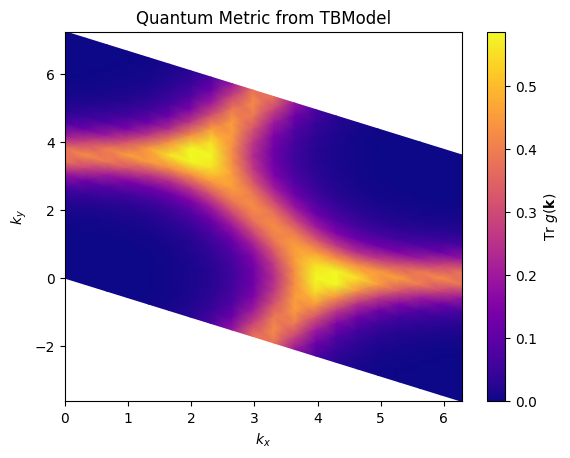
We can assert that the weak geometric bound \(| \Omega_{xy} | \leq \text{Tr}\ g\) holds everywhere.
np.all(abs(b_curv).real <= tr_g.real)
np.True_
As well as the strong bound \(\frac{1}{4}| \Omega_{xy} |^2 \leq \ \text{det}\ g\)
np.amax((1 / 4) * abs(b_curv).real ** 2 - det_g.real)
np.float64(5.551115123125783e-17)